




Why dogs can predict seizures in people

There’s a category of dogs around the world trained to accompany people with specific health conditions. They can detect changes in the human body by smell before they become noticeable. This isn’t a “sixth sense” or “magic.” These are specific biological mechanisms that science is actively studying.
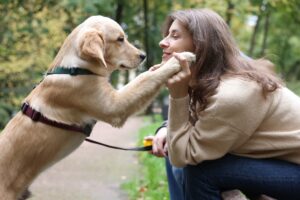
In the UK, there’s an organization called Medical Detection Dogs. Founded in 2008, its dogs—ordinary Labradors, Golden Retrievers, and Springer Spaniels are trained to accompany people with specific health conditions. And these dogs can do something that seems almost impossible to humans: they sense changes in their owner’s body by smell, sometimes before the person notices them themselves.
This isn’t a “sixth sense” or “magic.” It’s the work of specific biological mechanisms that science is currently actively studying.
The most important of these is the canine sense of smell. Dogs have approximately 220 million olfactory receptors, compared to 5 million in humans. The part of the brain responsible for processing odors is 40 times larger in dogs relative to their overall brain size. Dogs can detect odors at a concentration of one molecule per trillion air molecules.
When a change occurs in the human body—a hormonal shift, a biochemical shift, some physiological process—it’s accompanied by the release of odor molecules. These are invisible to us, but noticeable to a dog . And a dog trained to recognize a specific change can respond to it in a specific way.
Cynologist Anna Efremova, an expert with the Russian Cynological Federation, put it this way on the “Sobakin” podcast: “Assistance dogs are not ‘miracles of nature.’ They are highly finely tuned biological instruments, trained for a specific task. And when we say a dog ‘predicts’ something, it means they’ve detected a change before the human sensed it.”
Below is how exactly it works, what science already knows, and what is still in question.

How it all began
The history of assistance dogs began in the 1980s in the UK. The first documented program involved dogs serving people with type 1 diabetes, a condition in which blood sugar levels can plummet or rise sharply, requiring a quick response.
The idea arose by chance. Several dog owners noticed that their pets began to behave unusually (barking, pushing, rubbing) some time before a person’s critical moment. At first, this was attributed to coincidence. Then, to “dog intuition.” And then scientists suggested: perhaps the dog could smell the change.
In 2003, the British Medical Journal published a report detailing real-life cases of dogs alerting their owners to an impending critical drop in blood sugar. This was the first serious scientific documentation of the phenomenon.
In 2008, Claire Guest and John Charles founded Medical Detection Dogs in the UK. Their goal is to specifically train dogs for people with specific health conditions. By 2024, the organization had trained over 130 assistance dogs and remains one of the most renowned in the world.
In 2015, Claire Guest and colleagues published a study in the Journal of the Royal Society of Medicine. It documented specific cases in which trained dogs accurately recognized changes in their owners’ bodies. This made the phenomenon scientifically proven, rather than just anecdotal evidence.
What does a dog really feel?
Care is needed here. Every state of the human body has its own biochemical “signature .” When a sudden change occurs—for example, a shift in blood sugar levels—the body triggers a cascade of processes: the composition of sweat, breath, skin secretions, and sometimes even the odor of clothing changes.
For humans, these changes are almost imperceptible. For a dog, it’s a change in a familiar scent pattern that it notices.
What’s important to understand is that a dog doesn’t “know” about illness in the human sense. It doesn’t understand medicine, hormones, or physiology. To it, it’s simply a change in its owner’s scent, like if you suddenly changed your perfume or started smelling different. The dog notices this change and, if trained, reacts to it in a certain way.
In a publication on the Zooinform portal, Dmitry Kovalev, a breeder and RKF expert, put it this way: “Assistance dogs are an example of how the simple biological abilities of an animal, properly trained and directed, can solve problems inaccessible to human technology. No modern electronic device can detect a person’s condition by scent faster or more accurately than a trained dog. It’s not magic; it’s simply a different physiology.”
Is it possible to know in advance that something will happen?
This is the most controversial scientific question in this field. There are three categories of assistance dogs, and they work differently.
The first category: reactive dogs. These dogs respond to a change that has already begun. When it occurs, the dog gives a signal—barking, nudging the owner, or fetching a specific object. This is a well-studied and scientifically proven ability. Most modern service dogs operate in this manner.
The second category: “predictive” dogs. They are said to be able to signal 15-45 minutes before a critical moment. The scientific evidence here is more controversial. Some studies support this, while others do not. A possible explanation is that the dog detects very subtle early changes in odor, which normally precede more drastic changes. However, there is insufficient evidence to prove that this occurs consistently in all trained dogs.
The third category: companion dogs. They don’t “signal” in the technical sense, but rather provide psychological support to people with disabilities. This is the most common category. Effectiveness here is measured not by signals but by reducing the owner’s stress and increasing their confidence and independence.
Canine expert Tatyana Ivanova, an RKF expert, noted in an article for the magazine “My Friend Dog”: “When we say that a dog ‘predicts,’ this is only true in specific, scientifically documented cases. Most assistance dogs act as ‘living sensors,’ reacting to the current situation. This is already impressive. The idea that ‘a dog senses something half an hour in advance’ is an area where scientific evidence is still accumulating.”
What breeds are chosen for this type of work?
Although every dog has a well-developed sense of smell, specific breeds are used to work as assistants.
The Labrador Retriever is the most popular breed. Reasons: a strong sense of smell, a very friendly nature, excellent trainability, and calmness in public places. Labrador retrievers are not wary of strangers, do not react aggressively, and are willing to work all day long. They are an ideal breed for living with people 24/7.
The Golden Retriever is the second most common choice. A close relative of the Labrador, it shares similar qualities but has a gentler temperament. It’s a good choice for families with children and older owners.
The Poodle (standard, not toy) is the third most common breed. Poodles have a strong sense of smell (from their hunting heritage), are highly intelligent, and are easily trained. An added bonus is that they shed very little, which is important for those with allergies to dog hair.
English Cocker Spaniel – sometimes chosen for its compactness and agility.
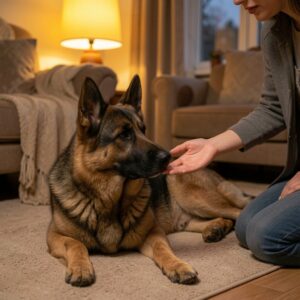
German Shepherd – less common, mainly for more serious tasks or for people with limited mobility, where physical assistance is also needed.
It’s important to understand: not every dog of these breeds is suitable for this type of work. Of a hundred Labrador puppies born under normal conditions, only 5-10 will prove potentially suitable. Of these, only 1-3 will successfully complete the full training program. This means that the “average” Labrador breed has a keen sense of smell and temperament, but a specific dog must also possess a very stable psyche, excellent trainability, and calmness in stressful situations.
Breeder Victoria Morozova noted in a publication on the Zooinform portal: “Training a single service dog costs tens of thousands of dollars and takes 1.5–2 years of intensive work. This is a serious industry. Therefore, the selection of puppies begins even before birth—by parents, by bloodline, by specific characteristics. A ‘random’ dog is not suitable for this kind of work.”
Is it possible to train a domestic dog?
The question often arises: is it possible to train “your” Labrador to notice changes in a person?
Technically, it’s theoretically possible. Practically, it’s very difficult and not always feasible. For several reasons.
Firstly, specialized training requires professional dog handlers who specialize in this type of work. Such specialists are very few in Russia.
Secondly, a scientific approach is needed: samples of the odor changes to which the dog needs to be “tuned” are collected in specialized laboratory conditions. Without them, the dog cannot be trained to recognize anything specific.
Third, the dog itself must be selected. Not every Labrador can work as a helper—specific characteristics are needed, which are only apparent to a specialist from the puppy’s first months of life.
What can be done is to train a pet dog to pay general attention to its owner. Many owners notice that their dogs naturally become sensitive to their condition, especially if the owner leads an active lifestyle with the dog. This isn’t “training special skills,” but it’s still a valuable bond.
Cynologist and RKF expert Sergei Belyaev put it this way in a publication on the ZooMir portal: “If you have a pet dog and you want it to be sensitive to you, spend more time together. Walks, games, training. A dog that knows its owner well naturally notices changes in their behavior and mood. This isn’t ‘medical care,’ but it is a real connection.”
In which countries is this developed?
There are several organizations worldwide today that specialize in training service dogs:
-
UK – Medical Detection Dogs (Buckinghamshire), mentioned at the beginning of the article.
-
USA – several organizations, including Diabetic Alert Dogs of America.
-
Canada – Lions Foundation of Canada Dog Guides.
-
Germany, the Netherlands, Sweden, and Switzerland are national associations that mainly work with Labradors and Retrievers.
There are still few specialized organizations in Russia. Some people in need of assistance dogs turn to centers abroad. But in recent years, Russian initiatives have begun to emerge—primarily in Moscow and St. Petersburg.
It’s a slow process—training requires significant infrastructure, specialists, and funding. But interest is growing.
What is important to know in the end?
If we summarize everything we have discussed, several important things become clear.
Canine assistance is a real scientific phenomenon, based on specific biological abilities. It’s not “magic” or “intuition,” but a keen sense of smell and proper training.
Not all “smart dog stories” are attributed to service dogs. Sometimes owners see their pet’s ordinary sensitivity as a “predictive ability.” This could be a coincidence, the dog’s general attentiveness, or a genuine skill. To distinguish this, systematic observation and, preferably, a specialist are needed.
Not every breed and not every dog can work as a service dog. It requires rigorous selection and extensive training. That’s why service dogs are expensive—but they also work differently than regular pets.
And finally, if you have a regular dog, not specially trained, but you notice it’s behaving unusually, pay attention to it. Not as a “medical alert,” but as a signal that something has changed. Dogs often notice changes in our moods, environment, and daily routine—and sometimes it’s worth listening to them.
Do you or someone you know have a dog that has surprised you with its sensitivity to people? Has it noticed when you’re upset, reacted to changes in the family, or behaved in a special way when stressed or tired? True stories are often more impressive than scientific data.