

3 Ways to Evaluate a Dog’s Intelligence

Here’s a question I hear all the time: “How can you tell if a dog is smart?” And I smile every time, because this question is both simple and bottomless.
How can you tell if someone is smart? From one conversation? From one situation? Unlikely. It’s the same story with dogs, only even more interesting.
I think we often confuse obedience with intelligence. A dog that instantly obeys the “sit” command is a trained dog. But a dog that looks at a closed door, then at you, then back at the door and whines softly, clearly hinting that it’s time to open it—that says something about its intelligence.
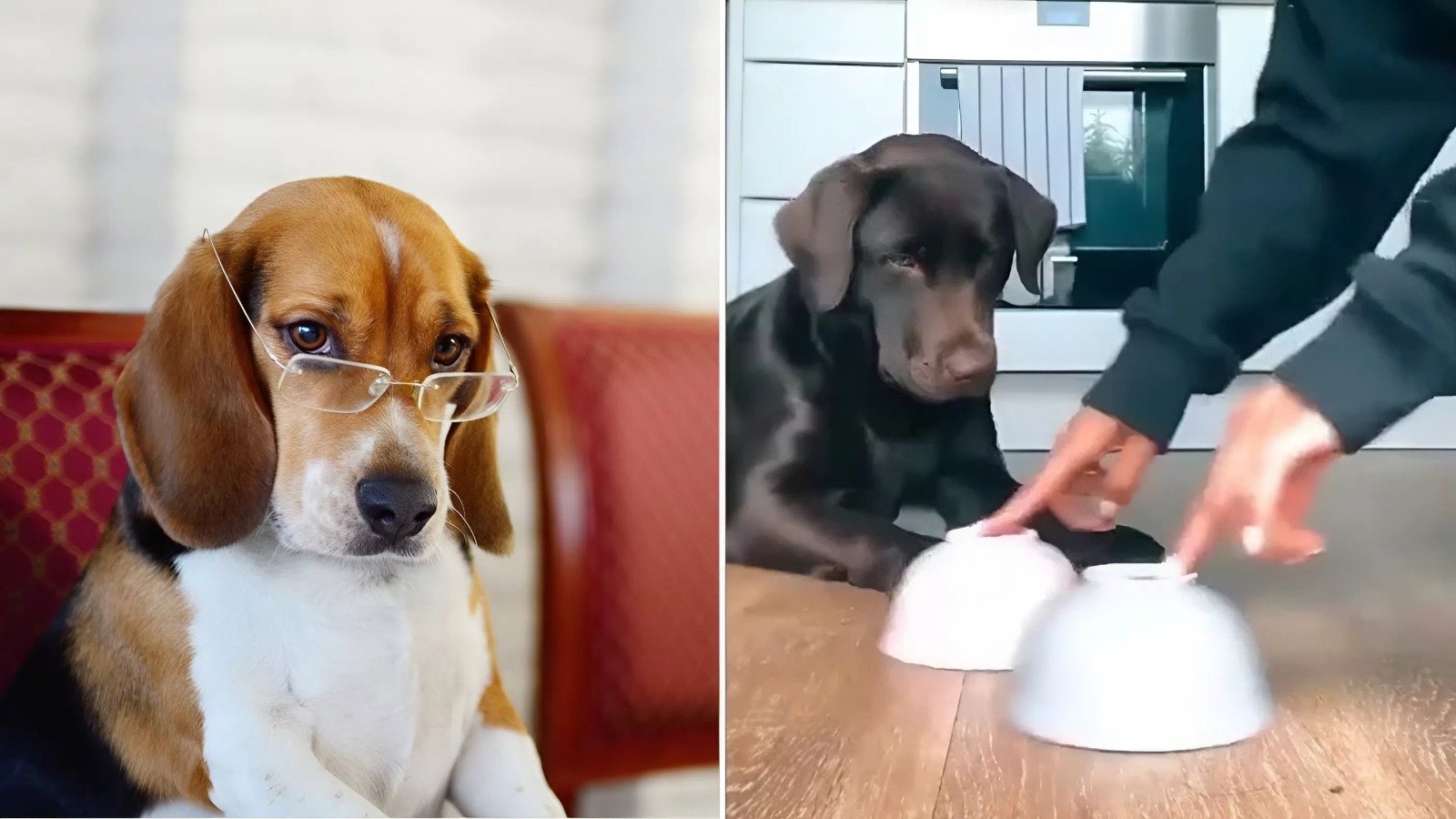
Today I’d like to share three methods that, in my experience, really help you understand how your four-legged friend’s mind works. No labs, no special equipment—just you, your dog, and a few treats.
Test One: “The Workaround,” or a Test of Resourcefulness
This is perhaps the most revealing test I know. It’s ridiculously simple, but the dogs’ reactions are priceless.
Take your dog’s favorite treat and place it where he can see and smell it, but can’t reach it directly. For example, behind a low partition, under an overturned bowl with a small gap, or behind the bars of an open cage on the other side.
The main condition is to figure out how to get to the treat. You can’t just reach it with your paw.
And here’s where things get interesting. Some dogs immediately start fidgeting: barking, whining, literally trying to smash their foreheads into the barrier. This isn’t bad, it’s just one type of reaction—emotional, impulsive.
Other dogs do something amazing: they stop. They literally freeze for a second, then start to go around the obstacle, looking for another way, trying different directions.
That pause—it says a lot. It’s the moment when the dog, roughly speaking, “thinks.” He doesn’t react instinctively, but analyzes the situation.
Important point: don’t expect the same results from all dogs, even if they are the same breed and raised in the same conditions. Behavior is a highly individual matter.
One dog can solve a problem in ten seconds, another in a minute, and a third will come up with a completely unconventional solution you never expected. And all three are smart, just in different ways.
Tip: Conduct the test when the dog is neither too hungry nor too full. If the dog is completely unmotivated, the results will be unfair. And don’t help, even if you really want to. Give it time.
Test Two: “Signal – Reward,” or Memory and Learning Test
This test is about something else—it shows how quickly your dog picks up on patterns. Incidentally, this is one of the most important markers of intelligence—in humans, too.
The pattern is this: You do the same action or make the same sound several times in a row—and it’s always followed by something pleasant: a walk, a toy, a treat.
For example, you clap your hands and go to the bowl. Or you say a certain word and take the leash. The key is a clear connection: signal plus result.
In my observations, most dogs begin to respond to the signal after three to five repetitions. But the quality of this response is what matters. Some dogs simply become excited by the sound because “something good is about to happen.”
Others—and this is much more interesting—start to initiate. That is, the dog comes up to you, looks expectantly, and… pats the floor with its paw. Or sits down in front of the leash and looks at you with an expression of “come on, you know what to do.”
This is called reverse transference: the dog didn’t just remember the connection, it understood the mechanism and began using it. This is a high level.
A few fair caveats: The speed of learning depends greatly on the dog’s age, its experience with people, and, of course, its temperament.
A young dog raised in active interaction with its owner will likely grasp things faster than an adult shelter dog who spent most of its life in isolation. This doesn’t mean the latter is dumber. It just means they have different life experiences. Intelligence and ability are not the same thing.
And one more thing: don’t be surprised if your dog suddenly “forgets” the sequence the next day. This is normal. Repeat the test. Sometimes it takes several sessions for the knowledge to truly sink in.
Test Three: “Three Bowls,” or a test of spatial memory
This is my favorite because it’s simple, visual, and incredibly engaging—especially if you have kids, they’ll love it.
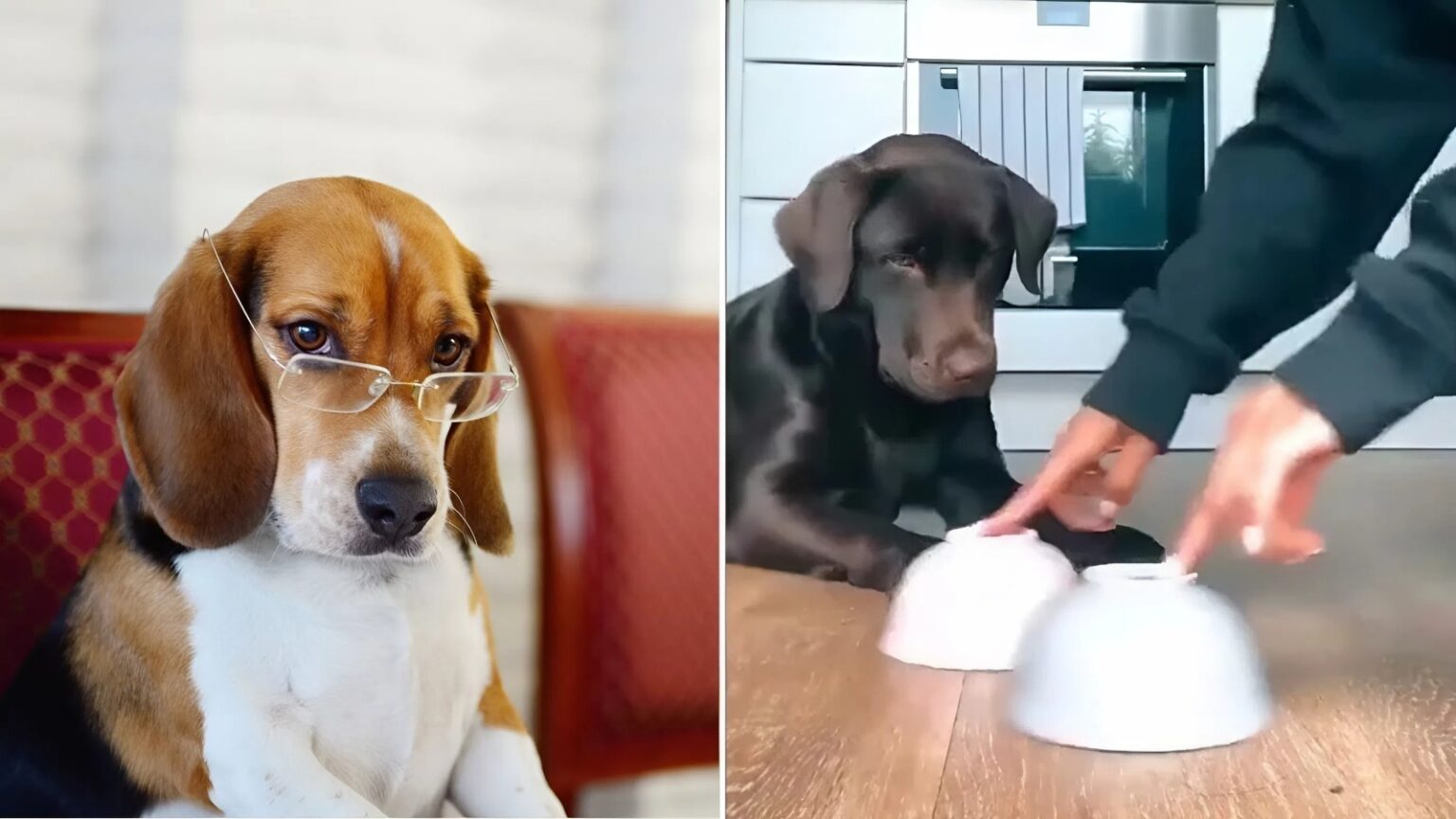
Take three identical opaque bowls or glasses. Turn them upside down. In front of your dog, hide a treat under one of the bowls—slowly, so the dog can clearly see where it is.
Then distract him for a second—just ask him to turn away or wave your hand to the side. And watch which bowl he goes to.
Basic level: The dog goes to the correct bowl immediately. This indicates that it has memorized the location and hasn’t been distracted.
The advanced level involves slowly swapping the bowls while the dog watches. This is where the real test of concentration and tracking begins. The dog must keep its eyes on the correct bowl, despite the movement of the others. This isn’t as easy as it seems—try focusing on the desired object among the moving ones.
I’ve noticed that some dogs literally never take their eyes off the correct bowl – not for a second, not with any movement.
Others get confused and start sniffing all three in a row, and that’s also normal: they use a different sensory channel—olfaction—instead of vision. And dogs’ sense of smell, as you can imagine, is a whole other topic for discussion.
Important: If a dog sniffs all the bowls and eventually finds the right one, it doesn’t fail the test. It’s simply a different strategy. Dogs aren’t required to solve problems the same way humans would.
Why One Test Is Never the Answer

I want to stop here and say something important. It’s perhaps the most valuable part of the entire article.
Intelligence is a multifaceted thing. Humans have emotional intelligence, spatial intelligence, logical intelligence, and social intelligence. Dogs have the same, only in their own coordinate system.
One dog is brilliant at spatial tasks but slow at picking up on social cues. Another is the opposite: she literally reads your mood from your breathing, but is at a loss with three bowls.
Furthermore, test results are influenced by a host of external factors: how tired the dog is, how motivated they are by the treat, whether there are distracting smells or sounds nearby, and how they’re feeling physically. One bad day, and you’ll draw the wrong conclusion about your own dog.
So my three tests aren’t an exam. They’re a game. A way to better understand your dog, to see how they think, what motivates them, and where their strengths lie. And, frankly, to just spend time with them—fun, productive, and with treats.
Every dog is smart in its own way. Each is a unique individual, influenced by their upbringing, life history, temperament, health, and a thousand other factors. Even two puppies from the same litter can have completely different personalities and abilities. This isn’t a bug—it’s a feature.
If you try these tests, let me know how it goes! Seriously, I’m really curious. How did your dog handle the workaround? Did it take her a long time to figure it out? Did she find the right bowl right away? Or maybe she came up with some unconventional solution that surprised you?
Share them in the comments – I always enjoy reading stories like these. Because each dog is a separate universe, and there’s endless new things to learn about them.